Learn about your rights in the U.S. and about laws that affect you and your family with this Know Your Rights information from Immigrant Legal Advocacy Project.
A refugee is someone who is unable or unwilling to return to their country of origin owing to a well-founded fear of being persecuted for reasons of race, religion, nationality, membership of a particular social group, or political opinion (UNHCR)
Please reference this video for further information on who refugees are and how they arrive in the United States.
Refugee and asylum seeker are both terms that are thrown around often interchangeably within the media, but they refer to distinctly different groups of people. Refugees have had their asylum case examined and have been given a positive decision on their asylum. In the United States, refugees have the right to reside and work here indefinitely and eventually apply for US citizenship.
Asylum seekers are individuals from foreign countries who made the request for asylum within another country, like the United States, but have yet to receive a positive or negative decision to be granted asylum. If this request was made within the United States, they are legally allowed to reside (and work after 180 days) within the United States until a determination regarding their asylum case has been made.
The Office of Maine Refugee Services (OMRS) serves individuals who qualify for ORR-funded services. This includes refugees, asylees, Cuban and Haitian entrants, Iraqi and Afghan Special Immigrants, Amerasians, Victims of human trafficking, Afghan Humanitarian Parolees, and Ukrainian Humanitarian Parolees.
Please visit the Office of Refugee Resettlement (ORR) for more information on eligibility and benefits.
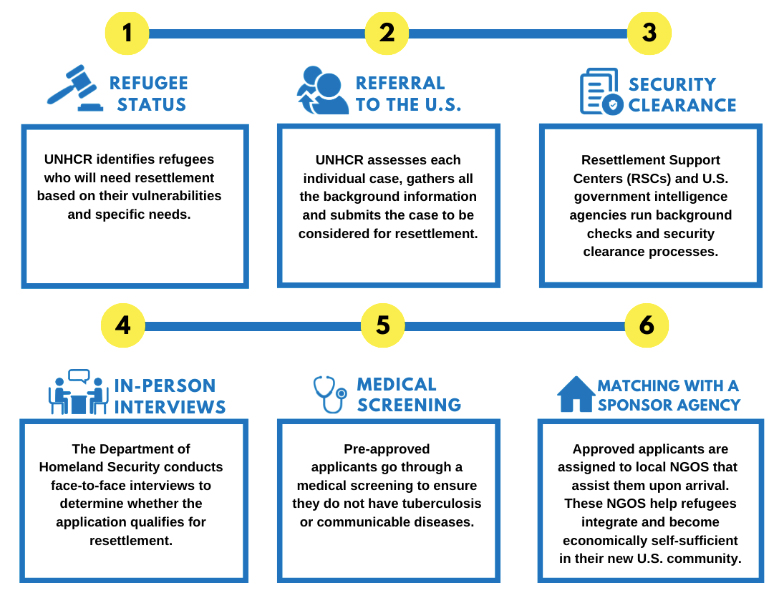
Resettlement to the United States is a two-part process for refugees that can be understood as the pre-arrival and post-arrival process. The pre-arrival refugee process for refugees located outside the United States is the responsibility of the US State Dept., US Dept. for Homeland Security, and the United Nations High Commission for Refugees (UNHCR). These agencies hear refugee's asylum claims, investigate them, and then determine their validity while the refugee is hosted in a third country. If approved, UNHCR refers a certain number of refugees, that the United States agrees to voluntarily, to resettle within its borders. That process can be seen below
USA for UNHCR: Refugee Resettlement to US, Pre-arrival
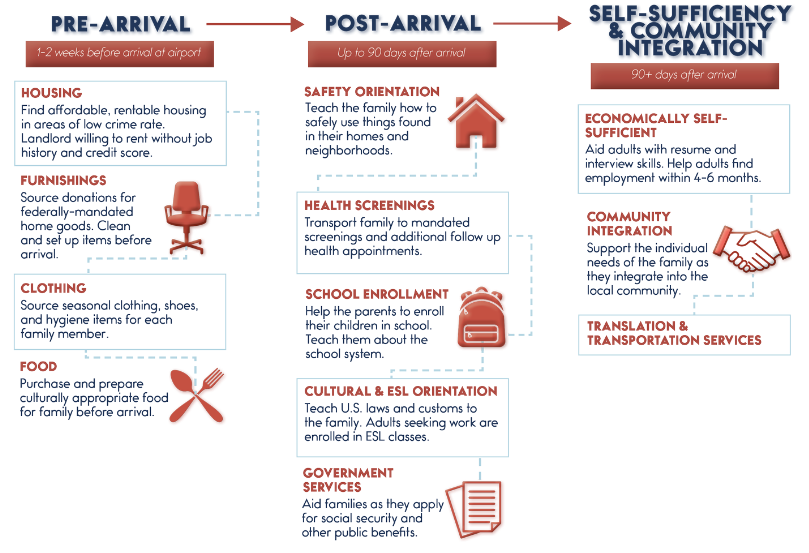
After step 6, refugees are matched with a resettlement agency, like one of the three located in Maine, and receive case management and other federal benefit programs designed to assist with their resettlement and integration. This process is overseen by the US State Dept., and the US Dept. for Health and Human Services. Refugees are eligible for case management services and other benefit programs for up to 5 years after their date of first arrival in the US. This process can be seen in the graph below:
Catholic Charities: Refugee Resettlement Post-Arrival in the US
Applications for asylum within the US can be made by following these steps outlined here by USCIS, the federal agency responsible for the initiation of the asylum process. The Office of Maine Refugee Services is not responsible for receiving asylum applications.
Two major departments with immigrants and refugees. It is important to refer to the right department according to the need.
What is the difference between the two departments, OMRS and RIS?
No, they don’t. The President of the United States determines how many refugees are admitted into the U.S. each year, and then the national voluntary agencies decide how many refugees are resettled in each state. Both departments at Catholic Charities are informed after those decisions have been made. OMRS is only consulted for capacity determination solely from an advisory positions.
Refugee resettlement in the state of Maine is overseen by the State Refugee Coordinator (SRC), similar to the structure in the other 48 states involved in refugee resettlement in the United States. who heads the Office of Maine Refugee Services (OMRS). In the majority of states, the SRC is seated within state government offices, but in Maine the SRC is seated in a non profit organization, specifically in OMRS which is a department of Catholic Charities of Maine. The federal government's Office of Refugee Resettlement provides OMRS with funds to administer the refugee resettlement program in the state. OMRS in its role then sub-grants the funds to resettlement agencies, schools, clinics, and other nonprofit organizations that work directly with refugees across Maine. Please check the list of programs to see what programs are funded by OMRS.
Once you have received a positive asylum decision please call or visit the following resettlement agencies and someone will assist you with starting the process:
If you have refugee or asylee status, you can apply for naturalization after you have maintained permanent residency in the US for at least 5 years. After that, you can apply with US Customs and Immigration Services for citizenship. Please follow these instructions from USCIS.
You can expect the same thing as if any other person were to move into your community. Refugees being resettled will not dramatically change the landscape of your community or negatively impact how you engage with your community. Refugees rather can be seen as contributors to the economy of your community in the long run! Refugees were found to have contributed nearly $124 billion more to the federal and state government budgets than the cost of refugee programs. For more information on the economic contributions of refugees, read here.
Potential employers are encouraged to consider hiring a refugee! Refugees are a great fit to any team. There are many reasons that refugees make great workers, such as their high productivity and the fact they have already been vetted by the US Dept. Of Homeland Security, please read more about why you should hire a refugee here.
Please reach out to one of the three resettlement agencies if you would like to inquire how to get connected with refugees to discuss potential job opportunities: MEIRS, RIS, and JCA

© 2026 Catholic Charities Maine